
Physical AI hands for stock iOS.
100% local. Hardware optional.
6.8ms local computer vision + 71Hz physical USB/BLE HID closed-loop control for unjailbroken iPhones. Bring any off-the-shelf $6 ESP32-S3 board (or optional pre-flashed hardware) — no jailbreak, no Developer Mode, no cloud lock-in.
6.8ms / 71Hz Latency Stress Benchmark · Uncut stock iPhone 16 Plus · 0 LLM tokens
ONE PRIMITIVE · INFINITE WORKFLOWS
If a human eye can see it and a finger can tap it, your code can drive it.
Do not stop at fixed presets. Tapveo turns any stock iPhone on your desk into a 60fps visible, 71Hz touchable programmable surface — locally, deterministically, and strictly on devices you own.
Give Any AI Agent a Real iPhone on Your Desk
Stop confining Claude, Codex, or local LLMs to browser tabs and narrow APIs. Hand your agent a real stock iPhone to orchestrate Apple Health, smart-home panels, personal trackers, notes, or any personal app that never shipped an API.
Millisecond Control Beyond Turn-Based AI
Turn-based vision agents stall for 3–5 seconds per screenshot. With a 6.8ms optical loop and 71Hz physical HID, your code can run 60fps arcade stress benchmarks, play live iOS synths and creative apps, or trace smooth continuous gestures.
Try the live 89ms reflex benchmark →Test What Simulators and Cloud Farms Can't Touch
Pair spare iPhones with $6 ESP32-S3 boards to build a local hardware-in-the-loop bench. Exercise real iOS permission dialogs, Settings toggles, Bluetooth/NFC peripherals, camera flows, and cross-app CI regressions.
Desktop Superpowers, Accessibility & Human Sign-Off
Bring low-latency mouse and keyboard iPhone control to Linux and Windows workstations, wire voice or assistive triggers directly into physical taps, or let local scripts pre-stage creator drafts for instant one-tap human approval.
observe() → track(6.8ms) → tap / drag(71Hz) → verify()
One open physical primitive. Build anything from a 10-line personal shortcut to a full desk-scale lab — in Rust, Python, or MCP.
ARCHITECTURAL TRADE-OFFS
Choose the right approach for your workflow.
Each iOS automation approach is built for a different job. Here is where physical closed-loop control fits alongside established tools.
| Dimension | TapveoLocal CV + USB/BLE HID | OS Debug BridgesXCUITest / WDA / Mirroring | Cloud Device FarmsHosted real-device grids | Pure VLM AgentsScreenshot → cloud model |
|---|---|---|---|---|
| Best for | Real-time closed-loop control, stock iOS, local privacy, cross-app & IoT flows | White-box CI for your own apps with native accessibility tree access | Broad OS and device-model compatibility matrices across managed fleets | Open-ended exploration on unfamiliar or frequently changing screens |
| Device setup | Stock iOS, no jailbreak, no Developer Mode (standard USB/BLE HID) | Requires Developer Mode, code signing, or mounted developer disk | Managed remote devices; zero local hardware required | Depends on host transport (software bridge or external HID) |
| Privacy & network | 100% local LAN; iPhone keeps normal Wi-Fi; no screen uploads | Local USB/LAN tethered; coupled to host/iOS versions | Test sessions run on third-party hosted infrastructure | Screenshots typically sent to remote vision APIs |
| Loop latency | 6.8ms local CV / 71Hz HID (0 LLM tokens during execution) | Fast UI-tree queries; slower when OCR/VLM fallback is needed | Network round-trip plus remote video stream latency | ~1–5s per cloud model inference turn |
| Targeting method | ~0.1–1.3pt optical closed-loop cursor verification | Native accessibility selectors (exact inside instrumented apps) | Accessibility selectors or coordinate playback | Vision-model coordinate prediction per step |
| Cost & hardware | Apache-2.0 Open Core ($0) + any $6 ESP32-S3 board (DevKit optional) | Free open-source tooling (macOS host often required) | Recurring monthly per-device subscription | Ongoing vision-model token usage per step |
LIVE INTERACTIVE BENCHMARK · ARENA 01
Think your fingers can beat a $6 ESP32-S3?
Tapveo clocked 89ms reaction and 192ms/target on stock iOS. Take the 15-second Reflex Sprint in your browser and compare against the global leaderboard.
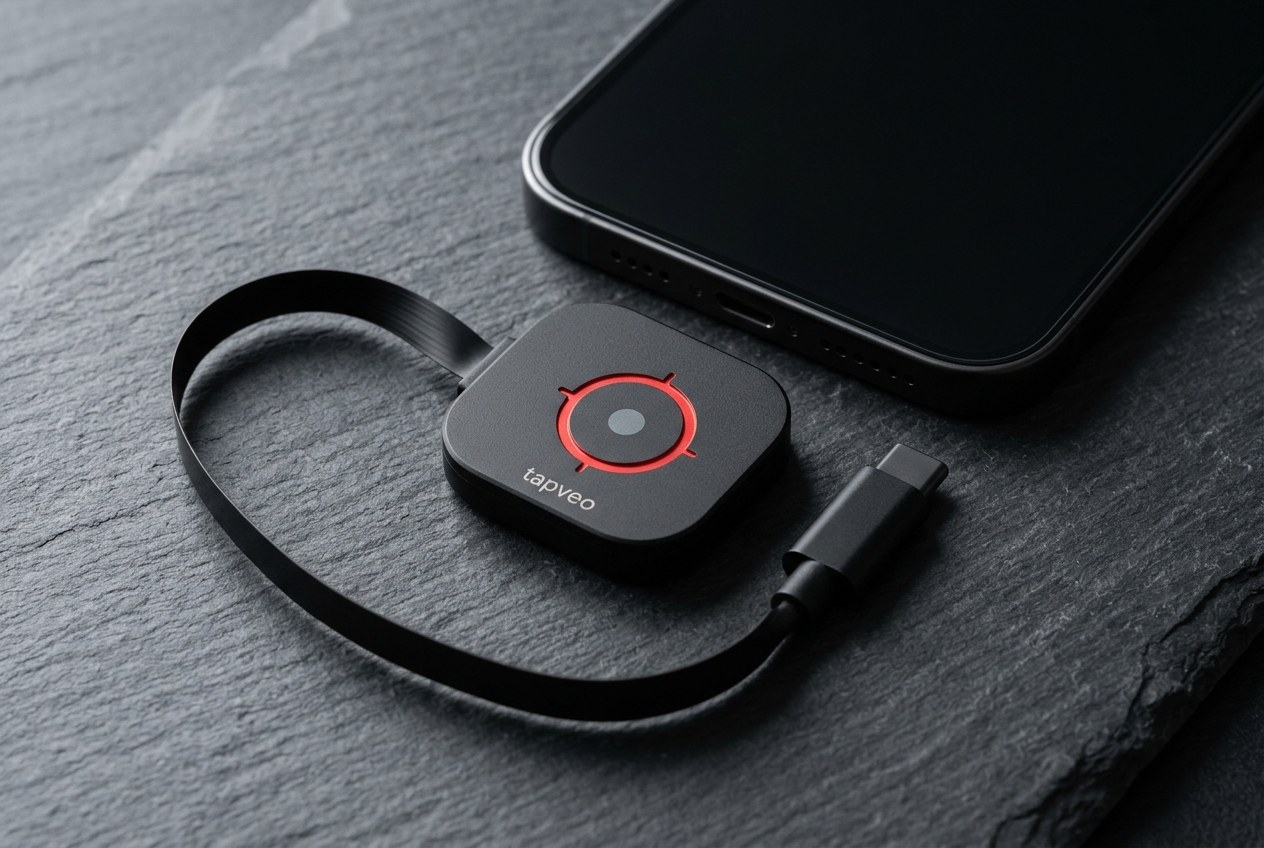
Concept render of the optional magnetic puck — or flash any off-the-shelf $6 ESP32-S3 board today.
HARDWARE IS OPTIONAL · NO LOCK-IN
Bring any $6 ESP32-S3 board — or opt for turnkey hardware later.
Tapveo firmware runs on standard, off-the-shelf ESP32-S3 boards (such as Seeed XIAO ESP32-S3). Prefer zero sourcing or flashing? Optional pre-flashed hardware will be offered based on demand — never required.
Desk Mode (BLE HID · Zero Wi-Fi Setup)
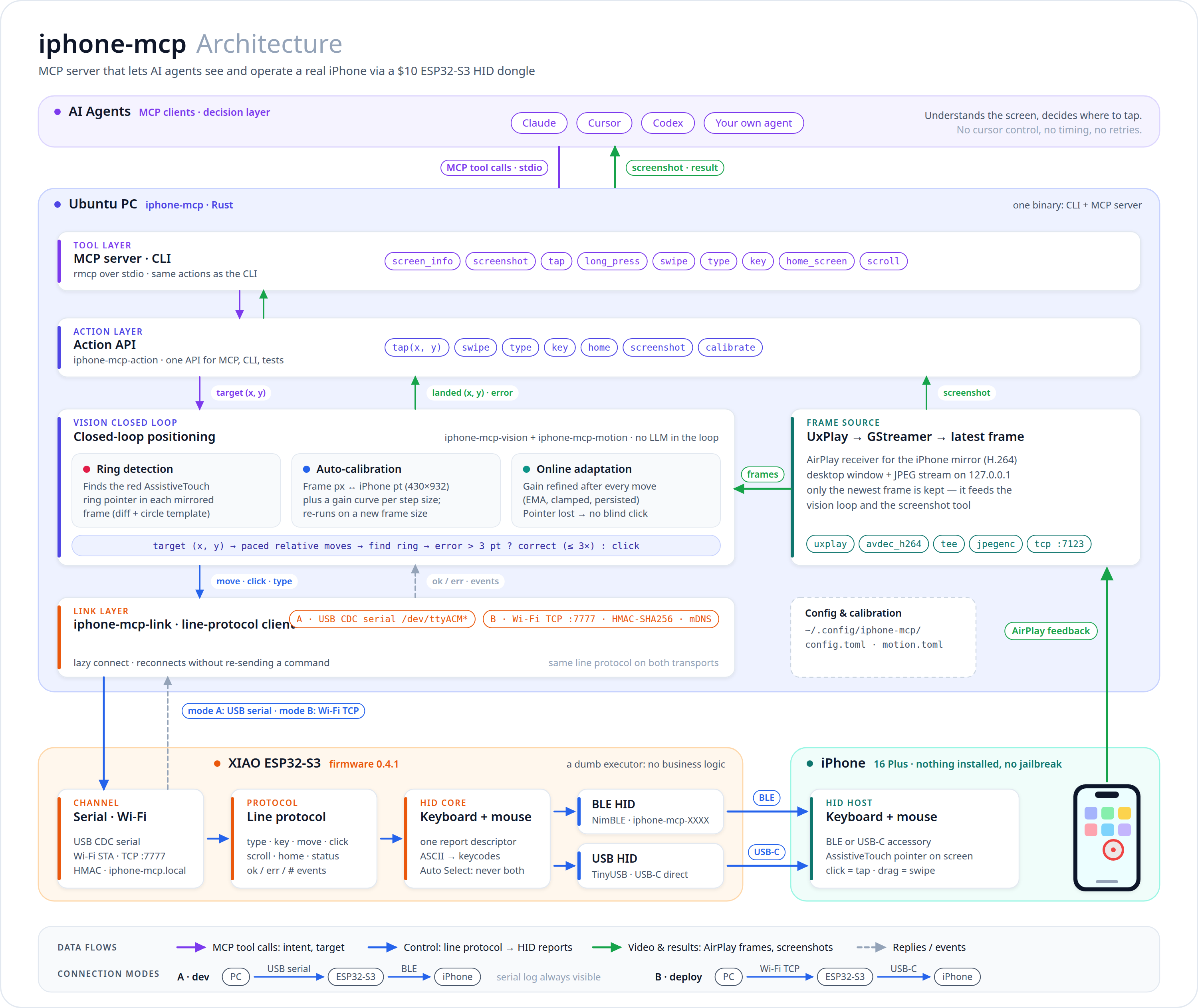
Works on any supported ESP32-S3 board plugged straight into your Mac, Linux, or Windows workstation. Communicates over USB serial while driving your iPhone via Bluetooth LE HID — keeping your iPhone's USB-C port completely free for charging or stands.
Wired Pro Mode (USB HID · Up to 71Hz)
Connect your ESP32-S3 board directly to the iPhone USB-C port for native USB HID at up to 71Hz, controlled over trusted LAN Wi-Fi TCP with HMAC-SHA256 authentication.
ARCHITECTURE & FAIL-CLOSED SAFETY
Local-first control with deterministic guardrails.
Built for white-hat real-device QA, accessibility, and human-in-the-loop creator workflows on devices you own.
100% Local Execution
Screen mirroring, Rust computer vision, and HID commands stay strictly on your local network. Zero cloud relays or third-party screen uploads.
HMAC-SHA256 Auth
Every TCP control session authenticates via challenge-response HMAC-SHA256 against a local secret token stored in ESP32 NVS.
Foreground Lock & Hold
MCP sessions verify expected foreground pages before every action. One command (hold) immediately freezes all physical output.
White-Hat & Human-in-the-Loop
Designed strictly for authorized QA and personal workflows with staged human sign-off. Zero CAPTCHA bypasses, zero bulk spam.
OPEN CORE · FLEXIBLE ROADMAP
Start free with your own board. Upgrade only if you want convenience.
No forced hardware bundle. We are prioritizing Tapveo Studio, browser flashing, and optional turnkey hardware directly from early-access demand.
Open Core (BYOH)
Full ESP32-S3 USB/BLE HID firmware, Rust host CLI/MCP server, and closed-loop vision engine.
- Works with off-the-shelf $6–$10 ESP32-S3 boards
- Closed-loop optical cursor tracking
- Native MCP Server + fail-closed guards
Tapveo Studio
Zero-setup desktop app for macOS, Linux & Windows — built for builders who want visual workflows without hand-wiring scripts.
- Built-in low-latency mirror + live CV overlay
- Visual recorder → deterministic 0-token MCP skills
- Browser one-click firmware flasher & replay logs
Optional Hardware & Teams
For commercial QA teams or users who prefer turnkey pre-flashed hardware and multi-device CI orchestration.
- Optional pre-flashed magnetic puck (never required)
- Multi-device local iOS QA bench & CI integration
- Audit recordings & dedicated team support
GUIDES & DEEP DIVES
Step-by-step playbooks for builders.
Practical tutorials covering cross-OS desktop control, Claude/Codex MCP integration, and Mac-free real-device iOS QA.
Control an iPhone from Linux or Windows
An AirPlay + $6 ESP32-S3 alternative to macOS iPhone Mirroring — mouse, keyboard, and CLI control with zero jailbreak.
Give Claude, Codex, or Cursor Physical Hands
Connect stdio MCP tools with 6.8ms local vision, 71Hz physical HID, and fail-closed safety guardrails on stock iOS.
iOS Testing Without a Mac or Xcode
Catch real mobile Safari/PWA bugs and test cross-app flows from Linux or Windows without WebDriverAgent signing.
FREQUENTLY ASKED QUESTIONS
Direct answers for builders & AI search.
Can an AI agent control a stock iPhone without jailbreak or Developer Mode?
Yes. Tapveo uses standard AirPlay screen mirroring for visual observation and a $6 ESP32-S3 enumerating as a standard USB or Bluetooth LE HID mouse and keyboard, so the iPhone stays completely stock with zero jailbreak, zero Developer Mode, and zero on-device software.
How do I control an iPhone from Linux or Windows?
Unlike Apple's macOS-only iPhone Mirroring, Tapveo runs its Rust host, AirPlay mirror pipeline, and ESP32-S3 HID bridge on Linux, Windows, and macOS over USB serial or local LAN Wi-Fi.
Do I have to buy proprietary Tapveo hardware?
No. Tapveo Core firmware runs on standard off-the-shelf ESP32-S3 boards such as Seeed Studio XIAO ESP32-S3 (~$6–$10), and can be flashed in 20 seconds from Chrome or Edge at tapveo.com/flash. Turnkey pre-flashed hardware is strictly optional.
How is Tapveo different from pure VLM agents or XCUITest?
XCUITest requires Developer Mode and works best inside your own app's accessibility tree. Pure VLM agents take 1–5 seconds per cloud model turn. Tapveo runs a 6.8ms local optical closed-loop with 71Hz physical HID and 0 LLM tokens during execution, working across system prompts and any app on stock iOS.
Does Tapveo upload my iPhone screen or credentials to any cloud?
No. Screen mirroring, Rust computer vision, and HID control run 100% locally on your LAN, authenticated with local HMAC-SHA256 tokens stored in ESP32 NVS.
EARLY ACCESS & ROADMAP INPUT
Help shape what we ship next.
Open Core is ready on GitHub today. Join the early-access list if you want Tapveo Studio, browser one-click flashing, optional pre-flashed hardware, or multi-device QA — your choices directly guide our roadmap.
Need multi-device QA or custom team integration? Email hello@tapveo.com.
Just want to report a bug or share quick feedback without joining the waitlist?